

In this post share, from an escrow perspective, what should be considered when items are left behind before or after a real estate transaction closes. Have you had something similar happen with one of your transactions?
Cash Hidden in the Walls
“My buyers found envelopes of cash in the wall during renovations. Who does it belong to?”
Who legally owns it?
In Washington, the deed transfers real property at recording. Personal property does not automatically transfer with the deed unless specifically included in the purchase and sale agreement (PSA).
Cash hidden in a wall is not a fixture. It’s not attached in a way that makes it part of the real property. It is personal property.
If discovered after closing and recording, the buyer now possesses the property — but that does not automatically make them the legal owner. Washington law on “found property” can require reasonable efforts to locate the true owner. That could mean:
- The seller
- A prior owner
- An estate
- In rare cases, reporting unclaimed property
Escrow’s role ends at recording and disbursement. We don’t adjudicate ownership of found items. If there’s a dispute, the parties may need to resolve it privately or through legal counsel.
What if it’s found before vs. after recording?
This is where timing matters.
Before recording:
The seller still owns the property. If discovered during a final walkthrough, this becomes a negotiable item before escrow closes. Agents can amend the PSA or negotiate disposition. Escrow can only follow written mutual instructions.
After recording:
Title has transferred. Escrow is closed. At that point, it’s no longer an escrow matter — it’s a legal/property issue between parties.
Agent takeaway: If anything unusual is discovered before signing, pause and document. Once recording happens, leverage shifts dramatically.
 A Car Still in the Garage
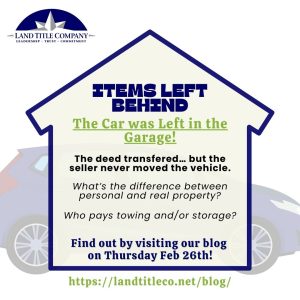
“The deed recorded, but the seller left a car in the garage. Now what?”
Personal Property vs. Real Property
Under Washington law and NWMLS forms, the deed conveys real property — the land and fixtures.
A vehicle is personal property. Unless specifically included in the PSA, it was never part of the transaction.
If the seller leaves a car behind, it’s not automatically the buyer’s car. It’s abandoned personal property.
Who pays towing and/or storage?
This depends on timing and contract language.
Before recording:
Failure to remove personal property may be a seller performance issue. The buyer can delay closing (if contractual timelines allow) or request escrow holdback with mutual written instructions.
After recording:
The buyer now owns the real property and is in possession. Washington has specific procedures regarding abandoned vehicles. Typically:
- The buyer must follow statutory abandoned vehicle procedures.
- Costs of towing/storage may initially fall on the property owner (the buyer), who may then pursue reimbursement from the seller.
Escrow cannot release funds post-closing without mutual written authorization or a court order. That’s why pre-closing walkthroughs matter so much.
Agent takeaway: If the garage isn’t empty at final walkthrough, don’t “assume it’ll be fine.” Once we record, remedies narrow and become more complicated.
 Livestock in the Backyard
Chickens. Goats. Even an occasional pig.
This one raises more than just eyebrows.
Zoning Violations
Whether livestock is allowed depends on local zoning regulations (city or county). If animals are not permitted under zoning rules, the issue isn’t just removal — it may involve municipal compliance.
Escrow does not police zoning, but we do see transactions delayed when buyers discover non-conforming uses late in the process.
Home Owners’ Association Implications
If the property is subject to an Home Owners Association (HOA), governing documents often restrict livestock.
Under Washington law, resale certificates and HOA documents are delivered to the buyer before closing. Buyers have a statutory right to review and, within a limited timeframe, rescind based on HOA disclosures.
If chickens are happily living in a backyard where CC&Rs prohibit them, that’s a red flag to address before closing.
Buyer Leverage Before Signing
Before signing and before recording:
- Buyers can demand removal.
- Buyers can request repairs for property damage caused by animals.
- Buyers can negotiate credits or holdbacks (with mutual instructions to escrow).
After signing and recording?
Leverage is mostly gone. It becomes a post-closing dispute.
Agent takeaway: Use the final walkthrough as a true verification of seller performance. Escrow can only act on written, mutual instructions before closing.
The Escrow Perspective: Why Timing Is Everything
From our side of the desk, everything hinges on one moment:
Recording.
In Washington:
- The deed records.
- Funds disburse.
- The transaction closes.
- Escrow’s authority ends (absent mutual instructions or legal order).
Before recording, agents and parties have flexibility.
After recording, solutions often require cooperation… or attorneys.
Practical Tips for Brokers:
- Take final walkthroughs seriously — not as a formality.
- Document issues immediately.
- Send written amendments or holdback agreements before signing.
- Remember that escrow is a neutral third party — we follow written instructions consistent with Washington law and NWMLS rules.
- When in doubt, pause closing rather than fix it later.
We love creative questions on Facebook because they spark great conversations — but they also highlight real risk management moments in your transactions.
If you ever have a “Wait… what happens if…?” scenario, call your escrow officer early. The best solutions happen before recording, not after.
And yes — if your buyers find something unusual in the walls — call us before they start spending it.